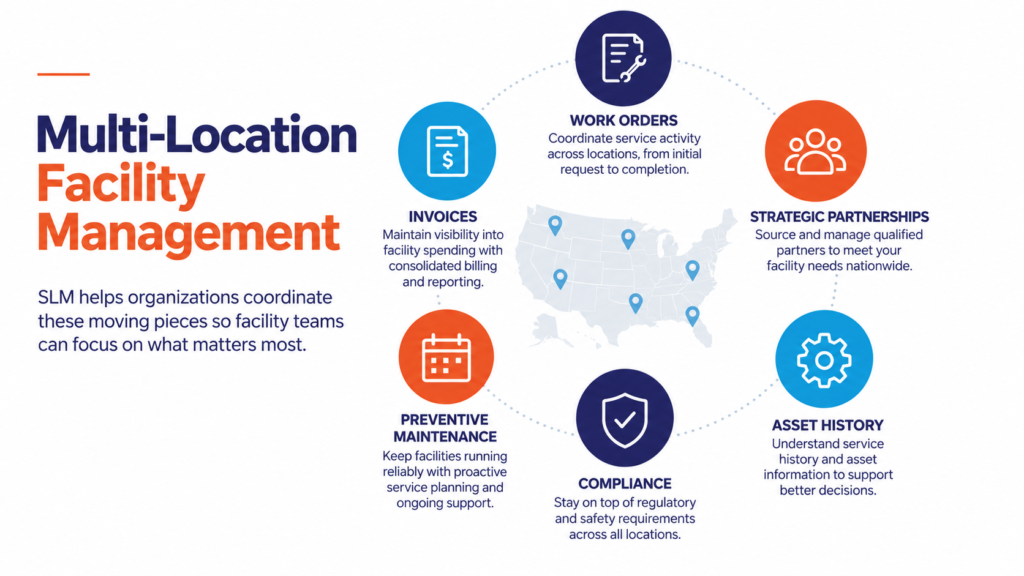
Multi-location facility management requires coordination across many moving parts, especially for organizations managing dozens or hundreds of locations. Work orders, service providers, invoices, asset histories, preventive maintenance activities, and compliance requirements may all be managed across different locations, departments, and systems.
For most multi-location organizations, having information in different places is a normal part of doing business. Facilities, operations, finance, and other teams each rely on different systems and processes to manage their responsibilities.
The challenge comes when that information is difficult to connect and use.
Without a clear view of facility activity across locations, facilities leaders can spend valuable time tracking down information, reconciling service activity, and answering questions that should be easier to address.
Better coordination and facility reporting can help organizations understand what is happening across their portfolio, identify trends, evaluate service provider performance, and make more informed operational decisions.
The Challenge Is Not More Data. It Is Making Facility Information Useful.
Most multi-location organizations already have significant amounts of facility information.
Work orders may be managed through one process. Invoices flow through finance. Asset information may live somewhere else. Service providers maintain their own records. Preventive maintenance schedules and compliance documentation may be managed separately.
The opportunity is to bring enough consistency and visibility to facility operations that leaders can better understand what is happening across locations.
That can help answer questions such as:
- Why are maintenance costs increasing in a particular region?
- Which assets are generating repeat service calls?
- Are certain locations experiencing similar maintenance issues?
- How consistently are service providers responding and completing work?
- Where are emergency repairs occurring most frequently?
- Which assets may warrant replacement instead of continued repair?
Answering these questions requires more than collecting data. It requires consistent processes, coordinated facility service management, and reporting that helps turn service activity into useful operational insight.
1. Facility Reporting Requires More Manual Effort
Reporting becomes more time-consuming when facility information has to be gathered from multiple sources.
Facilities teams may find themselves combining spreadsheets, reviewing work order histories, reconciling invoice information, matching service activity to locations or assets, and validating service provider performance.
The issue is not necessarily a lack of information. It is the time required to organize that information into a useful view of facility operations.
For teams responsible for large multi-location portfolios, more consistent facility reporting can create greater visibility while allowing internal resources to stay focused on operational priorities.
2. Recurring Maintenance Issues Are Harder to Recognize
A single repair may not appear significant.
Four repairs on the same refrigeration unit within six months tell a different story.
When maintenance activity is viewed one work order at a time, patterns can be easy to miss. The same applies to recurring HVAC failures, repeat service calls, high-maintenance locations, or equipment that requires increasingly frequent attention.
Reviewing service history across locations and assets can make recurring maintenance patterns easier to recognize and help facilities teams ask more informed questions.
Is the issue related to the equipment? Is it specific to a location? Is the current service approach working? Is the asset reaching a point where replacement should be considered?
Connecting service activity provides context that can support better facility management decisions.
3. Budget Planning Can Become More Reactive
Facilities departments are often expected to provide leadership with a clear understanding of maintenance spending and future needs.
That may include questions such as:
- Why did maintenance spending increase?
- Which locations are driving costs?
- Where are emergency services occurring most frequently?
- Is preventive maintenance helping reduce unplanned repairs?
- Which assets may require future capital investment?
Without consistent visibility across facility activity, answering those questions can require significant manual effort.
Better coordination between facilities, operations, finance, and service partners can provide a clearer picture of maintenance activity and help organizations make more informed planning decisions.
4. Service Provider Performance Is Harder to Evaluate
Multi-location organizations may work with numerous service providers across trades, markets, and regions.
Completing a work order is only one measure of performance.
Facilities teams may also need visibility into response times, repeat service calls, completion performance, invoicing, and overall service consistency.
When service information is managed differently across locations or providers, comparing performance can become difficult.
Consistent oversight and reporting give facilities leaders a clearer understanding of service provider performance and help identify opportunities to improve accountability and service consistency across the portfolio.
5. The Full Cost of Maintaining Facility Assets Can Be Difficult to See
Repair decisions often happen in real time. An asset fails, service is requested, and the equipment is repaired.
But the current repair is only part of the asset’s history.
When the same equipment requires repeated service, facilities teams need visibility into previous repairs, service frequency, and associated costs to understand the bigger picture.
A more complete view of asset maintenance history can help facilities leaders make informed repair-versus-replace decisions and identify equipment that may require longer-term capital planning.
The goal is not simply to reduce maintenance spending. It is to make informed decisions about how and where maintenance resources are used.
6. Compliance Requires Consistency Across Locations
Multi-location organizations can have a wide range of facility compliance requirements depending on their industry, services, equipment, and locations.
Managing those requirements at scale depends on consistent processes and reliable documentation.
When inspection information, corrective actions, maintenance records, and supporting documentation are managed separately, locating the right information can take additional time.
A coordinated facilities management approach can help create greater consistency in how service activity and documentation are managed across locations, supporting stronger operational oversight.
7. Facilities and Finance May Not Have the Same View of Spending
Facilities and finance often look at maintenance activity from different perspectives.
Facilities teams need to know whether work was completed, whether the issue was resolved, and whether an asset or location requires additional attention.
Finance teams need accurate invoices, appropriate coding, and greater visibility into spending and budget performance.
When those workflows are not well connected, teams may spend additional time reconciling invoices, reviewing service activity, and identifying what is driving facility expenses.
Greater alignment between facility service activity and financial information can help both teams understand not only what was spent, but also the operational activity behind that spending.
Turning Facility Information Into Better Operational Decisions
The goal for multi-location organizations is not necessarily to move every piece of facility information into a single system.
It is to create enough consistency across locations, service providers, processes, and internal functions that leaders have the visibility they need to make informed decisions.
That means establishing consistent processes for managing work, tracking service activity, evaluating providers, reviewing costs, and reporting on performance.
With stronger coordination, organizations can:
- Make recurring maintenance patterns easier to recognize
- Better understand facility cost drivers
- Evaluate service provider performance
- Improve consistency across locations
- Provide useful information for maintenance budgeting and capital planning
- Reduce manual administrative work
- Provide leadership with clearer operational insights
The value is not simply having more facility data. It is having useful information that supports better decisions.
How SLM Facility Solutions Nationwide Supports Multi-Location Operations
At SLM Facility Solutions Nationwide, we believe facilities management should not distract organizations from what matters most: serving their customers.
As an outsourced facilities management partner, SLM helps multi-location businesses coordinate, streamline, and manage facility services across locations, supporting a more consistent approach to multi-location facility management.
Our team works alongside customers’ internal resources to coordinate facility services, manage service activity, support service provider performance, and create greater consistency across the locations and services we manage.
Through our facilities management team and nationwide network of strategic service partners, we provide responsive support designed to help customers manage facility operations with greater confidence.
SLM does not replace every system or solve every data challenge within an organization.
Instead, we help create greater coordination, consistency, accountability, and visibility across the facility services and strategic partners we manage. This allows internal teams to spend less time managing day-to-day facility complexity and stay focused on their customers and operations.
Creating Greater Visibility in Multi-Location Facility Management
Facility information will continue to exist across different people, systems, service providers, and business functions.
The opportunity is to manage facility activity in a way that makes that information easier to understand and act on.
With consistent processes, coordinated service management, and clearer facility reporting, multi-location organizations can better understand maintenance activity, service provider performance, costs, and recurring issues across their portfolio.
For facilities leaders, that means greater operational visibility and more useful information to support the decisions they make every day.
Looking for a more coordinated approach to managing facility services across multiple locations? Learn how SLM can help create greater consistency, visibility, and accountability across your facility operations.